Friday, May 27, 2011

Kilometers, kilometers, and more kilometers!

It's been quite a while since I last posted, and many, many things have happened since then. I'll try to give you a update on everything. I've included a few photos, although the links found on the right have full albums of my trips.

Semana Santa:

Rachel, Alicia and I left for our huge 1,800km trip for Semana Santa.

First stop: Merida. Walking around Merida at night seeing the Roman ruins lit up was breathtaking. It wonderful to see how they were so well kept for so long. Merida also boasts an impressive Roman amphitheater, one of the most complete still in existence today. Being able to witness the construction of buildings around a theater from over 2,000 years ago makes me have more faith in humanity; knowing that we can respectfully gaze upon our past while still moving into the future is essential to my belief in what lies ahead of us as a positive blend of cultural differences that have
changed throughout the course of history.


Second stop: Caceres. Although Caceres is relatively close to Merida, both located in Extremadura, it is completely different. While Merida embraces is Roman past, Caceres' old city walls protect an important slice of medieval/early modern Spain. Inside the walls exist a number of palaces and churches, showing off the lavish use of Gothic and Baroque architecture of the time. The Plaza Mayor, located just outside the old city walls, is immense and welcomes locals and tourists alike to kick back and enjoy the scenery. Caceres, like Merida, is a UNESCO World Heritage City.


Third stop: Trujillo. Trujillo is a small town, with a population of about 10,000. While small in size, this pueblo holds many treasures. It's Plaza Mayor is dominated by a large church; in front of the church is a statue in tribute to native trujillano Francisco Pizarro, who conquered Peru. The photo on the left shows one of the curious balconies, often used in the area during the time period. The ornate corner balcony is an eye-catching detail of the palace La Conquista, which also forms part of the Plaza Mayor. Siting above Trujillo is a castle, built by the Arabs during their reign of what is now Spain. We spent the night in a town outside of Trujillo and then continued on our trip north to the region of Castilla-Leon. While on our way there, the landscape changed completely as we drove through beautiful mountains and gained elevation. The temperature dropped significantly as we neared our next stop, Avila.


Fourth stop: Avila. While you may not have ever heard of Merida, Caceres or Trujillo, Avila is a more commonly heard name. This is because of a nun who later became one of the most important figures in the Catholic Church, Santa Teresa de Avila, or Santa Teresa de Jesus. Santa Teresa was born in Avila in 1515. She entered Monasterio de la Encarnacion as a novice. She later went on to reform the Carmelite order and found her own, the Discalced Carmelites. In 16th Century Spain, Santa Teresa was a fierce woman who not only opened many convents where extreme poverty was practiced, but she was also a prolific writer. Last year I focused a chapter of my thesis on her writings, specifically on the way she made use of the male-created rhetoric of the Church as women being "weak" with many "faults" in order to capture the attention of her male readers. She most certainly did capture their attention and even was examined under the Inquisition for the way she encouraged others to pray through mental prayer. After her death she was canonized and in 1970 Santa Teresa, along with Saint Catherine of Siena, was made the first woman Doctor of the Church. It was such a wonderful experience to be in the birthplace of la Santa and get a feel for the place she once lived in.

In addition to Avila's connection to Santa Teresa, Avila is known for it's magnificent city walls. Built in medieval times, Avila's walls are the only ones to be complete still today. We were able to walk along the interior side of the wall, from which we has a great view of the cities many churches and ornate cathedral. Avila is also famous for it's steak (yum!) which we, of course, enjoyed thoroughly. We stayed in an old palace from the 15th century just outside the Cathedral's doors. It was a pleasant stop along our journey, which led us to our next stop.
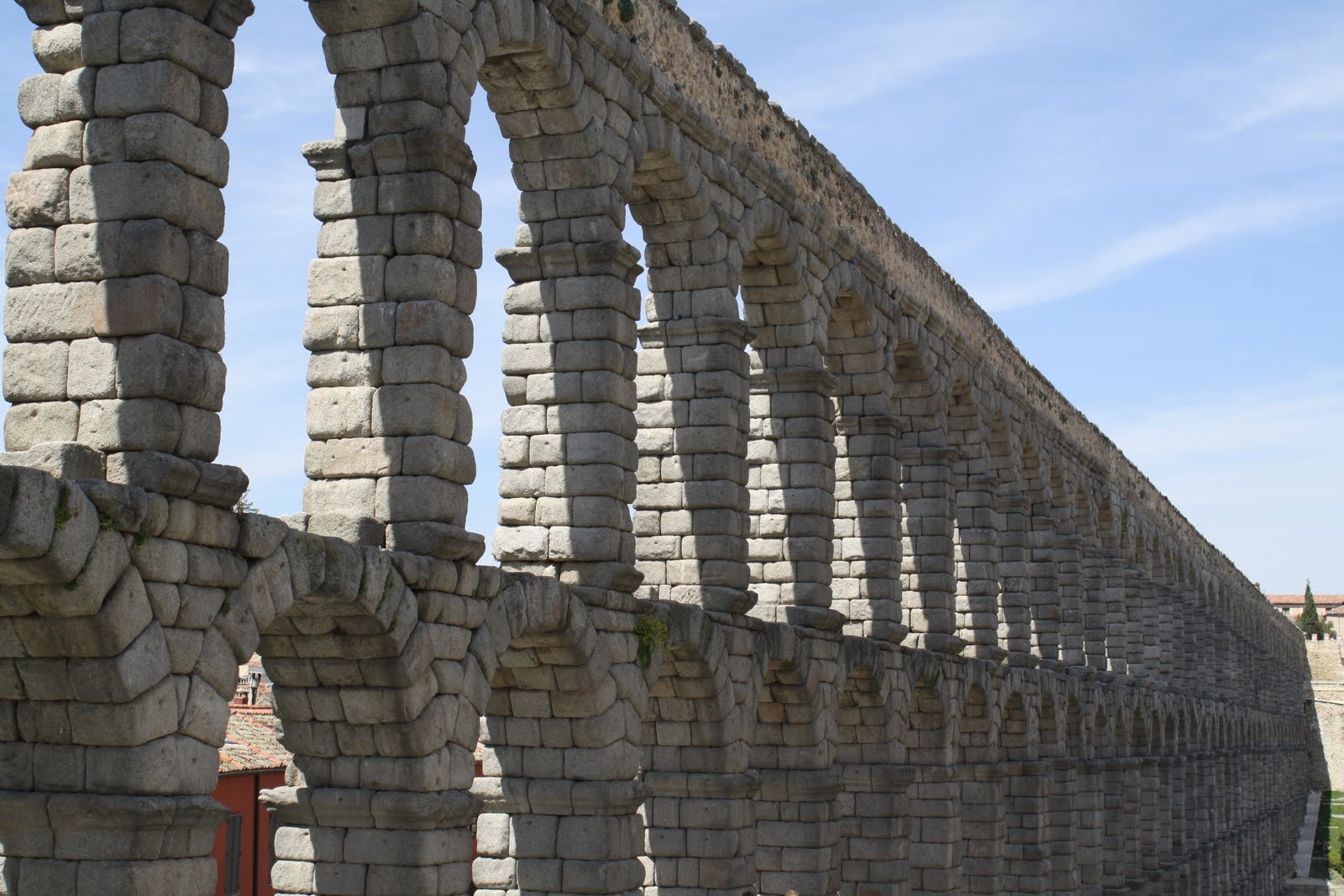

Fifth stop: Segovia. We arrived in Segovia and at lunch under it's aqueduct, one of the most famous in Spain. After eating lunch we headed towards the main part of the city. My day in Segovia was bitter-sweet; while walking along one of the streets, I got a call from my mom saying that my Grannie had passed away. I had been imagining the moment for months, but never would have expected that the call would come while on a trip. My mom comforted me on the phone, letting me know that she had a very peaceful passing. "It doesn't matter where you are; you can always pray for me," she told me in January. Her words filled my head and I knew that she would want me to continue on my trip, to think practically about taking advantage of the opportunities I had in that moment to see a new place and not sit and cry about something that could not be changed. While this was extremely hard, I was able to do so. Like my Grannie would have advised me, I said a prayer in Segovia's immense cathedral, swallowed my tears the best I could, and continued on my way.We continued our tour around Segovia, visiting the Alcazar and making our way through the old Jewish Quarter. In the late-afternoon we headed to our next stop, this time in Madrid.


Sixth stop: Alcala de Henares. The great writer, Miguel de Cervantes was supposedly born in Alcala de Henares (although Alcazar de San Juan also has evidence he was really from La Mancha). The old city center has held onto it's medieval roots, as can be seen in the cobbled streets and the style buildings. Rachel and I were able to catch a bit of Alcala's Semana Santa, which was especially impressive because the pasos we saw was at night, one of which was carried only by women. We were able to visit Cervantes' house, which has been turned into an excellent museum.


Seventh stop: Toledo. This stop wasn't planned out, but as we left Alcala for Marmolejo, we decided we could stop and have lunch in Toledo, as well spend a few hours exploring the city. I hadn't been to Toledo since I was sixteen, so it was a real treat to go back. Although we didn't do the least bit of justice to such an important part of Spain's history, it was a nice reminder of what I had seen seven years ago. We mostly wandered the streets, and visited the cathedral, which is known to be one of the most impressive in Spain. After our quick stop, we headed south.


Based out of Marmolejo, we went to Cordoba for the day to visit Nieves, my adviser and favorite professor from college. We had coffee together and it was really great to see her. I spent the rest of the week in Marmolejo with Alicia's family. It was great to experience Semana Santa in a pueblo, especially after having been in Sevilla, which is famous for it's Semana Santa, attracting tourists from all over the world. I woke up at 5am to see one of the pasos; it was absolutely beautiful to watch the Virgin Mary make her way through the streets of the town while the sun started to come up. Some of Alicia's friends were nazarenos/nazarenas, which means they make a promise to the Virgin and walk along side her in the processions, wearing hoods and robes. Many people walk barefoot as part of their penitence to Mary. In this photo you can see the black hoods of one of the hermandades.

We also started to prepare for Virgen de la Cabeza, which I'll discuss next. We celebrated Easter lunch with Alicia's friends at a restaurant in Marmolejo.


Virgen de la Cabeza:

Coming soon!

Patios de Cordoba:

Coming soon!

Algarve:

Coming soon!

Birthday Surprise Trip:

Alicia planned a surprise trip for me for my birthday. I had no idea where we were going, so you can imagine how fun it was/how antsy I was the whole five hours there. We ended up on a trip into Golden Age Spain. The first stop with Alcazar de San Juan, where there are records of the baptism of Miguel de Cervantes Saavedra, perhaps serving as proof that Cervantes was indeed born in La Mancha and not in Alcala de Henares. Nearby we visited four magnificent windmills, which Don Quixote supposedly thought were giants.

Windmills above Alcazar de San Juan

We continued with our Don Quixote theme and spent the following afternoon in El Toboso, hometown of the famed Dulcinea, Don Quixote's "lady love". In the photo you can see Mr. Quixote kneeling in salute to his love. The town devotes itself to Quixote-based tourism, and includes a number of fantastic museums, one of which holds over four-hundred copies of Don Quixote from all over the world, signed by the leaders of when they were collected - even Franco, Mussolini, and Hitler!


After a fantastic visit to El Toboso, we headed to our last stop, my beloved Almagro! What a surprise it was to be able to go back. While I have seen who knows how many pueblos, towns, and cities here in Spain, Almagro really has captured my heart. It's so different from the other cities I have seen, and despite it's small size, it's filled with many sites. Almagro has conserved it's Golden Age history in a way that really allows you to feel what it might have felt like in the time period. As I study Golden Age Spain, you can imagine how exciting it was to be there again. We went to see "Romeo and Juliet" at the Corral de Comedias, which we visited back in February. It was a great rendition - and totally strange to see it in Spanish... All the famous lines I have memorized didn't quite sound the same in another language. We stayed in the Parador, one of the many government owned hotels that a truly embody the beauty of Spain. The Parador in Almagro is in an old convent from the 17th century. It's absolutely stunning, and quite large - it has eleven patios (courtyards)!

Overall the trip was amazing - a wonderful birthday surprise indeed! Cheers to 23!


In Loving Memory
Elizabeth Mackay Galletto
"Grannie"


June 15, 1928 - April 18, 2011

Elizabeth M. Galletto, RN Passed away peacefully surrounded by her husband and family Monday, April 18th at her home. Elizabeth (Betty) was born June 15th, 1928 in The Bronx to James and Dolina Mackay of Scotland. Betty was a proud graduate of Bellevue Nursing School. She met her husband of 52 years, Dr. Antonio Galletto, while working together at Morrisania Hospital in New York City. She would fly west to San Francisco to marry Tony and begin their life together in California. Betty was a loving, dedicated mother to her 5 children, Maria (Richard), Paola (Daniel), James (Christine), Teresa (David), and Janet (Isaac). Dear sister of David Mackay. Cherished Grannie to Emmalie, Albert, Antonio, Dominic, Daniel, Jacob, Jessica, Peter and Mathew. Betty was a much loved zia of 12 nephews and nieces in Italy especially Monica & Giuseppe and Luigi & Beatrice who visited often, along with her cousins on the East Coast and in Scotland. Many thanks to her caregivers Cristina and Clare. "Mom" will always be remembered for her grace and unconditional love exuded throughout all of life's challenges. A selfless spirit who traveled life's journeys with a peaceful and positive Christian outlook. Her kindness and grace will be forever cherished by all who had the privilege of her company. May her journey on be filled with the same love she so willingly gave all of us here.

Thursday, April 14, 2011

Semana Santa Begins!

And so does la ruta grande!

Fuengirola
Merida
Caceres
Trujillo
Avila
Segovia
Alcala de Henares
Cordoba
Marmolejo
Fuengirola

:) Be on the lookout for photos and a new post very soon!

Thursday, March 31, 2011

Spain and English Language Learning

An interesting article written by Raphael Minder found in the NYTimes (published March 29, 2011). The article references the program I am a part of.

You can find it here:
http://www.nytimes.com/2011/03/30/world/europe/30iht-spain30.html?_r=2

In Troubled Spain, Boom Times for Foreign Languages

MADRID — Facing high unemployment at home, more Spaniards are seeking work abroad. But they are confronting a significant hurdle: their poor foreign-language skills, in particular a lack of English.

With a 20 percent unemployment rate, twice the European average, labor mobility has become a burning issue in Spain, prompting some business leaders to call for an overhaul of the Spanish education system that would make better language training a priority.

Emilio Cuatrecasas, chairman of Cuatrecasas, one of the biggest Spanish law firms, said recently that “Spain has to take seriously the need to reform its education, particularly in terms of teaching English.”

There are early suggestions that the next generation will have sufficient communications skills to work outside Spain: More children are now being taught by English speakers as part of their regular class work. At the same time, more adults are playing catch-up, notably trying learn German to respond to employment offers in Germany, which has the largest economy in Europe.

One place where educational changes are under way is Madrid. A program run by the regional government has made about a third of primary state schools bilingual. The government expects to raise that proportion to half by 2015.

On a recent morning at the Rosa Luxemburgo school in the district of Moncloa-Aravaca, 10-year-olds were studying the human body in English, learning terms like “salivary glands” and “esophagus.” One of them, Macarena Ferrán, said that she also got to practice English regularly while vacationing abroad, last summer in the Netherlands. As to her long-term ambition, “I would like to live in New York because it looks like a very interesting city,” she said in almost flawless English.

For the current generation of Spanish job-seekers, however, working in New York might be more of a distant dream. While there are no reliable comparative statistics, language-school owners like Richard Vaughan even argue that “the level of English is lower than 15 years ago,” reflecting a general decline in education standards in Spain.

Mr. Vaughan, a Texan who moved to Spain in the 1970s, now runs Vaughan Systems, the largest English language teaching company in Spain. He estimated that “fewer than 5 percent of the students graduating from schools of engineering, law or business possess a working knowledge of English.”

Spanish politicians are also among the worst in western Europe in terms of English skills. Neither the head of the Socialist government, Prime Minister José Luis Rodríguez Zapatero, nor the leader of the main opposition Popular party, Mariano Rajoy, speaks English.

Madrid’s bilingual program, however, is giving the region’s politicians something to gloat about.

“This is a major step,” said Lucía Figar, who oversees the regional government’s education policy. “Until very recently, getting to a decent level of English was simply impossible for any child whose parents didn’t have the money to send their child abroad or to a private school.”

The bilingual schools rely largely on Spanish teachers who get a monthly bonus of €180, about $255, for making the language switch. The schools also have recruited assistants who are native English speakers — often Americans on an extended university break or sent to Spain through an education scholarship like the Fulbright program.

Between 30 percent and 50 percent of the class work is in English, including the science that was being taught last week at the Rosa Luxemburgo school.

In another classroom, Felipe Alejandro Luna Merlo, an 8-year-old whose parents emigrated from Bolivia, was finding it more difficult to assimilate human anatomy in English, and struggling to understand general questions about his upbringing. Still, he sounded eager to progress, saying that he was also teaching his father, a waiter, how to say “the numbers and the colors” in English because “I really want him to learn like me.”

One of the teachers, Fernando Azpeitia, had spent three years in Chicago at a transitional school teaching Latino children. He welcomed the enthusiasm among his Madrid pupils. “The big advantage here is that parents have chosen to have their children learn English,” he said, “while in Chicago it was kind of compulsory.”

Whether the children always get to hear the Queen’s English is debatable, however, and even Ms. Figar acknowledges that some teachers could improve their own English. Still, she said, more than 90 percent of the children have so far completed their bilingual primary school program by passing English language tests set by Cambridge University.

“These tests are the best way to measure our success, rather than discussing whether some teachers have good grammar but poor pronunciation,” she said.

Indeed, pronunciation is rarely a Spanish strong suit. Last month, during the televised ceremony for the Goyas, Spanish cinema’s version of the Oscars, participants insisted that one nominated movie, “Buried,” should be called “Bar-y-ed.”

Ms. Figar also described as “absurd” the criticism directed last year at a €1.8 million Madrid advertising campaign to promote bilingual education. English purists said the slogan for the campaign — “Yes, we want!” — amounted to a grammatical error because a direct object should have followed the verb. “This was only about powerful advertising,” Ms. Figar said. When Apple promotes its consumer electronics, she added, “nobody questions whether their slogan should be ‘Think positive’ or ‘Think positively.”’

In collaboration with the Spanish Education Ministry, the British Council, Britain’s cultural agency, also runs a bilingual project in more than 200 schools, alongside similar initiatives in Italy and Portugal. Raising English standards in Spain “isn’t an overnight happening,” said Teresa Reilly, a British Council official. Still, compared with Portugal and Italy, “Spain is considerably ahead in the introduction and development of solid subject-based teaching in English in the primary and secondary sectors,” she said.

The economic crisis is also forcing more adult Spaniards to return to the classroom — and not just to learn English. Applications to learn German this spring semester have risen 15 percent from a year ago, according to the Madrid office of the Goethe-Institut, which promotes German culture abroad. That follows a recent recruitment initiative by the German government to add about 500,000 engineers from other countries to keep its economy growing.

Meanwhile, Miguel Flor de Lima, who teaches the Portuguese language in Madrid, said that a growing number of multinational corporations were cutting back marketing and other activities in Spain and Portugal, two of the most crippled economies in Europe.

“The crisis means that more companies are treating Spain and Portugal as a single Iberian market and then asking their people to adjust to that,” he said. “And that leaves employees with no other option than trying to master both languages.”

Friday, March 18, 2011

Tell Me What Your Future Holds...

I realize it has been weeks since I last left you with an update on life here in Spain. I had an almost complete post read to be published, but decided to sit on it and wait. It began a little something like this....
Last year at Mount Holyoke, my whole plan of getting my teacher's licensure, went haywire. Being too late to start applying to graduate schools, I accepted the new proposed plan of teaching in Spain. I wasn't very excited about it at all; that had never been something I had wanted to do. But I listened to the advice of my professor and did it. After all, I would at least have a plan for the next year, and a job, something many of my friends are still searching for. At first I was unsure about being placed in Fuengirola. I arrived and slowly began to get accustomed to my new home. While I was physically here, my mind was elsewhere the first few weeks. I was planning for my future, spending hours in front of my computer screen while writing personal statements, writing samples, and filling out applications to graduate school. It was the second half of my plan for this year. Teach in Spain, apply to grad school. And while I am totally a planner, I began to start to feel as if I wasn't really living in the moment. Somewhere within the first six weeks of being here I realized this, and with it, that maybe teaching in Spain isn't supposed to be a one year gig for me. Maybe it's something I would enjoy for two years.

So as I said, I applied to graduate school, finishing my applications in December while at home. Recently I just heard from two schools and was accepted at both. The program at the University of Georgia is a Master's which would take two years. The program at UC Berkeley is a PhD and would take six years.

So here is my dilemma: once I begin graduate school (especially a PhD program), there is no real going back. There's no stopping midway through a degree because life gets in the way. There's no picking up and moving to Spain to really LIVE my life instead of just planning it. My mind is flooded with questions: What about happiness? What is it anyway? Is it waking up smiling, knowing that you're going to be challenged in all sorts of ways, and that you'll be alive at the end of the day? Is it being surrounded by people who make you feel good? It is immersing yourself in something new and allowing that to become part of yourself? It is feeling that you have found your center? While I'm not sure that's what happiness is, that's how I feel every moment. For the first time in a long time I feel truly good, like I am LIVING my life. And now here is my next question: Why should we ever chose to leave a situation we are extremely happy in? Why should we ever give up an opportunity to continue? My entire life has been about making good decisions that make me a better person, that enrich my life in all sorts of ways. It's been about find new things to add to my personal growth. And for once I am not blindly taking the advice of my superiors and truly asking myself, if I am not doing any harm to myself by being here, why should I move forward? Why should I leave? I don't feel as if I am ready to leave, and I know that if I am in the US next year, I am going to be constantly asking myself why I missed out on such a fantastic opportunity.
Much has changed since I started to write that post. In reading through the department websites, I realized it would not be possible to defer for a year. And after hours upon hours and hundreds of dollars spent throughout the application process, I was not about the repeat it. In the end, I was accepted at all five universities, and thus began my decision process.
  • Boston University: Accepted. No financial aid. Out of the question.
  • University of Georgia: Accepted. Teaching Assistantship, tuition waived.
  • University of Oregon: Accepted. Teaching Assistantship, tuition waived.
  • Boston College: Accepted. Teaching Assistantship, merit scholarship for full-tuition.
  • UC Berkeley: Accepted. Teaching Assistantship, tuition waived.
While each of these schools have great programs, I decided it was really between UC Berkeley, a six-year PhD program, and Boston College, and two-year MA program. As exciting as it was to be accepted to Berkeley, the six-years were a little daunting. What if I don't like it? What about the state of the Californian economy? What happens if they pass the $500 million budget cuts to the UC system? What about academic resources? As I do not study contemporary literature, it makes more sense to be on the East Coast, with access to the libraries at Harvard, Yale, Brown, BU and the many other institutions in New England. (As you can see, I was starting to feel that BC would be the best bet.) Another factor about being at Berkeley was the proximity to home. While fantastic for millions of reasons, it is for exactly those reasons that made me think twice about being so close to home: six-years in a PhD program takes a lot of concentration. While at first thought the idea of living at home seemed fantastic, I began to think about it and imagine what it would be like. All I could picture was struggling to find a good balance between family and study. Perhaps this paints me as not-so-good of a person, but I believe the distance is necessary. I will be able to focus on my work while in Boston, and really enjoy my family when I come home. I won't feel as though I have to walk a fine line of balancing everything at the same time. The other wonderful thing about going to BC is that it is a two-year program, which will allow me to further assess my future once I am in the midst of my studies and not have to make a decision right now. While I am 90% positive I would like to enter academia, I have never been in a graduate school class. While a PhD is a more advanced degree, it is also prohibiting in terms of what jobs I would be able to take. Leaving with a MA in Spanish will permit me to enter a different field or different level of education, if need be. Lately I have been thinking about being a professor at a study abroad program here in Spain. It would have to be a smaller program, and I think I would like to work in a less popular city, as this would greatly affect the type of students I would be teaching.

En fin, come the beginning of September, I will be moving to Boston to start a Master's program in Hispanic Studies, under the Department of Romance Languages and Literatures at Boston College. It is also quite possible that I will live with my dear friend Zeinab, a fellow Mount Holyoke alumna from the class of 2010. We met during the summer of 2005 at a leadership conference and have been friends since. If all goes well, we will live together in the Brookline/Chestnut Hill area starting in September.

Getting back to my original post and upon much reflection, I have really learned something this year. I have learned to live in the moment in a way in which I never have before. I have taken every opportunity to travel around Spain, immerse myself in the rich history, culture and tradition. I have learned not to hold back, to actually live each day to its fullest potential and to rejoice in the small things. While many times I feel extremely sad when thinking I will not be back here next year, I have decided I am going to make the most of my time and ENJOY it.


Weekends since February: Trips we have taken, Plans we have made.

Feb 4-6: Marmolejo to visit Alicia's family AND learn how to make flamenquines, courtesy of Alicia's mom, Isabel.

Feb 11-13: La Mancha, specifically Almagro, Consuegra, Puerto Lapice, and Castillo de Calatrava. An absolutely amazing trip. Beautiful weather, towns filled with so much history. Windmills, Don Quijote's "castle", and the last surviving theater from the 17th century!

Feb 18-20: Ruky and Rachel came to visit. We went to Antequera.

Feb 25-Mar 6: Semana Blanca. My Aunt Lynne and cousins Andrew and Audrey came to visit. We went to Mijas, Malaga, Gibraltar, Ronda and Sevilla. We had SUCH a great week! From monkeys in Gibraltar to a night out in Sevilla to remember, it was definitely one of the best weeks I have ever had in Spain.

Mar 11-13: Fuengirola. Massive spring cleaning.

Mar 18-20: Jaen, Ubeda, Baeza

Mar 25-27: Fuengirola

Apr 1-3: Ruky visits. Granada

Apr 8-10: Toledo

Apr 15-19: (First half of Semana Santa) Merida, Caceres, Trujillo, Avila, Segovia, Alcala de Hernares

Apr 20-24: (Second half of Semana Santa) Cordoba, Marmolejo

Apr 29-May 1: Romeria de la Virgen de la Cabeza. SO excited!

May 6-8: Cordoba for la Cata and los Patios, two of Cordoba's famous happenings in May.

May 13-15: Algarve, Portugal. We scored the amazing deal: Two people, two nights, 5 Star Hotel, 66sq-km suite, Breakfast included. Value: 340 euro. We're paying 99. Yup, that's 25/person/night.

May 20-22: Fuengirola??? Sevilla?

May 27-29: Feria de Cordoba.

Eventually I am coming home... haha... Probably around June 13th or so. As you can see, we are definitely taking advantage of the time I am here. Once I get home, our travels will be on hold until July 12th when Alicia arrives in San Francisco. Then we will resume, this time in California! She is staying until August 24th. Beyond excited. :)

Jack Kerouac listed 30 "essentials" in his "Belief and Technique for Modern Prose". Number four reads:

4. Be in love with your life.

Why yes, sir, I am.

Thursday, February 3, 2011

Mini-Trips, Here & There...

Two weeks ago was my roommate's birthday. I decided to get tickets to a concert of one of her current favorite groups, and in doing so, take the opportunity to go on a mini-trip for the weekend.

On Friday after Alicia finished school, we took off for Granada. We arrived at our fancy, shmancy hotel which had an exact replica copy of the Arab Baths of the Alhambra! We wandered around the center for a bit, visiting the Albayzin, the small streets that still embody their Moorish past. The barrio is filled with little shops and tea rooms. We stopped in one of them and drank Moroccan tea while listening to the beautiful sounds that make you feel all the more like you have stepped into medieval Al-Andalus. Later on we met up with my good friend Marta. In Granada when you order a drink, they give you a free tapa to go along with it. (Good idea? No. Excellent idea!!) Ali, Marta and I went "bar-hopping" (if you can call it that), eating different types of tapas. Quite yummy if I do say so myself! The next morning Ali and I hit the Arab Baths; we decided on the Arab Circuit which follows this order: temperate water, hot water, freezing cold water, the Turkish steam room, and finally a rubdown with ice. It was excellent so we decided to do the circuit again. After the second round we sat in a dark, candle-lit room and drank delicious tea. We had such a great time that we decided we should return in another two weeks.

We left Granada around 2pm and headed to Alicante. While on the way, we saw all sorts of weather, and terrain: from tall, green trees covered in snow to big, beautiful white clouds in the bright blue skies. We stopped for a coffee in an enchanting little pueblo called Velez-Rubio. We continued on and stopped in Murcia for a quick visit with one of Ali's friends. He took us into the center of Murcia to see the Cathedral which has a magnificent facade. As the story goes, Alfonso X El Sabio went to Murcia and fell in love with the city. He requested that upon his death, his heart be buried in the Cathedral of Murcia.

From Murcia we continued to Santa Pola, a town about 30 minutes from Alicante capital. We ate delicious paella in a very local restaurant and later went to the Supersubmarina concert. The concert was awesome, loads of fun, and Ali had a good time. Mission Accomplished. The next day we headed to Alicante. The weather could not have been better! The sky was blue and the clouds, a stunning white. The water in Alicante was much more blue than here in Fuengirola, making the city even more picture-perfect. We started by heading up to Castillo de Santa Barbara, which is one of the biggest medieval fortresses in Spain. It's in excellent condition and provides views of the entire city. After many photos we turned our attention to our stomachs. We found a great little restaurant and ate fresh fish and paella. Yum! After our meal we wandered the streets of the old quarter and eventually found Barrio Santa Cruz. Absolutely precious! It's set up into the hill so you have to climb up the stairs to arrive at the top - no cars, only pedestrians. The "streets" are lined with painted pots and the flowers contrast with the stark white of the houses. As you walk higher and higher, there are ceramic tiles with poetic odes to the climb, to the Virgin, to Semana Santa. I can't imagine how difficult it must be to bring the Virgin down the stairs for Semana Santa or any other occasion... It was truly one of the most breathtaking neighborhoods I have seen in Spain. If you ever get the chance to go, Alicante is definitely worth a visit.

Sunday, January 23, 2011

Race in Spain

This past Saturday, we went to see Hairspray, a musical that has made its way from Broadway to the big screen and now to local stages around the world, including Fuengirola, Spain. Set in 1962 Baltimore, the play is about a teenage girl, Tracy, who dreams of dancing on the Corky Collins Show. She faces adversity from her peers because of her weight, and ends up in detention with many of the Black students of her school. It is there she learns new dance moves that get finally catch the attention of Corky Collins. When Tracy gets a chance to be on the show, she decides her dream shouldn't just stop with her. Tracy believes that both Blacks and Whites should be allowed to dance on the TV, and, after ending up in jail, achieves her goal and dances along with her Black friends on the show. Not extremely original, but it's a good story and has good musical numbers. Nothing too extreme... right?

Wrong. I should have known better before I went.

My excitement about seeing the musical went from 100 to 0 in about a second, as soon as I saw the black-faced Spaniards, dressed in clothes from America of the 1960's, come on to the stage. Blackface. It's something that one very, very rarely sees in the United States (and when such an incident occurs, it usually makes national news coverage, or at least there is conversation about it), but here in Spain there is an insensitivity to the issue. Their explanation is, "But that's what they look like," and it is very hard for them to understand our construction of race, the historical struggles that took place (and are taking place) in the United States and did not unfold in the same way in Spain. Saturday's production wasn't the first time I've seen blackface in Spain: I still remember being shocked beyond words when I saw a group of about twelve girls dressed as Mammies during Carnival two years ago, with their faces painted black, not brown, black. Last time I checked there weren't any people who existed on Earth whose skin was actually black... Another common time to see black-face is on the Epiphany with the Three Kings, or Reyes Magos, come. One of the three is black, and along with the one black-faced Spaniard comes his entourage or other black-faced Spaniards... Just thinking about it makes me feel extremely upset. What upset me so much about seeing the black-face this weekend in Hairspray was that the mother did not just have her face/body painted brown, but she wore bright red lipstick and blue eyeshadow. UGH!! REALLY?!?!?! I couldn't exactly leave the theater, so I closed my eyes, breathed slowly to stay calm, and tried to not focus too much on the characters who caused me so much internal friction. I made it to the end of the performance in one piece, consoled by the fact that I knew I was going to go home and blog about it.

There is currently a debate about this going on in the United States, about blackface and theater, and how to represent people of different races when they are portrayed by actors of a different race. While I understand how perhaps this could cause managers to become perplexed, it also angers me that another solution could not be found. I remember going to a production when I was about eleven years old which was set on a plantation during slavery. I still remember very clearly the way in which race was portrayed: each cast members, despite the color of their skin, wore a felt patch on their cheek to tell the audience what race the person they were portraying was. In fact, the slave owner was a Black boy who wore a peach-colored patch on his cheek. In other words, the director cast his actors according to their talent, not to their skin color. It made the production all the more beautiful, knowing that the Black boy could be cast as the protagonist and not just a slave based on the color of his skin.

For a little information about the historical significance of Blackface, click here.

Monday, January 10, 2011

De vuelta de nuevo

Hola once again from the sunny Costa del Sol!

Coming back to the warm weather makes it almost seem like Christmas break didn't even happen! But, indeed, it did happen. I spent all three weeks at home, mostly with my family and just a couple of friends. On Christmas Eve my Grannie got pneumonia, which really weakened her as she has liver cancer and tumors in her airway... :( But, my Grannie, being her strong, stubborn self, is starting to make a comeback, albeit with new modifications to the daily routine. I spent most of my time practicing my intrinsic nursing skills, which according to my Nonno, would have been a much better path for me. For now all we can do is pray, hope for the best, and be thankful for the many, many blessings we have received in life, as well as the time we have enjoyed together over the years.

Three Generations: Grannie, Mom & Me

I also finished my grad school applications while I was home, so that is great. Done! I am going to reapply to the program I am currently in, just in case I decide to defer on grad school/don't get in. Yikes, now that would be scary.

So here I am, back to my weekly routine of classes at school and private lessons/babysitting in the afternoon. No real changes as of yet (except that one of my vertebrae decided it wanted to pop out of my spine a bit -ouch). I'm looking forward to the next five months, and already starting to make plans, or at least deciding where I want to go before my time here is up. So far we've got Berlin, Morocco, Granada, Nerja, La Coruna (Galicia), Alicante, Valencia, Cordoba, Sevilla.... And maybe a trip to the UK, France and/or Italy. So many places to see! I want to try to see as much of Spain as is possible, and really see Andalucia in its entirety.

That's all for now. Stay well, stay happy, and keep smiling.

Thursday, December 23, 2010

Home for the Holidays

I suppose I owe you all an update on the many things that have been going on since I last wrote. Time just slips away here, and once again I have found myself very behind in blog updates. I will just write about a few of the highlights so as not to overwhelm you with details of my life.

Thanksgiving:

In preparation for Thanksgiving, my co-worker Nandi and I decided to do a whole-school project. We made a tree and cut out leafs for every student from 2-6 grade. Each student received a leaf and on it wrote, "I am thankful for..." and something they are thankful for. We taped the leafs to our tree in the hallway for the whole school to see. The 3-5 year olds and first graders made turkey hands. It was a huge hit!

Nandi showing off her leafs.


Me with my tree


To celebrate Thanksgiving, I had not one, but two dinners! The first one was in Cordoba with a group of Mount Holyoke girls: my friend Tilly (who came to visit from Germany), Liz (who works in Cordoba), Carmen (we celebrated at her house), and Stephanie (who was studying abroad in Sevilla). I cooked a turkey and we had the whole Thanksgiving works! See below:

Thanksgiving Round 1: Cordoba

Then I celebrated Thanksgiving Round 2 in Fuengirola with Rachel, my roommate Alicia, and our friends Carlos and Xavi. Rachel and I cooked for hours to give them a taste of a real Thankgiving (turkey, cranberry sauce, grave, mashed potatoes, sweet potatoes, stuffing, biscuits, pumpkin bread, apple pie...) and it turned out to be delicious!

Thanksgiving Round 2 in Fuengirola: Me and Rachel preparing dinner


Portugal

As soon as Thanksgiving had come and gone, it was time for a trip to Portugal! In Spain we have almost a whole week off for different holidays. Rachel and I decided to take advantage of the "puente" (literally bridge, meaning long weekend) and started to plan our adventure to the other Iberian country. Our group grew to three and then four. My friend Caitlin who lives in Sevilla and my Sevillana friend Silvia joined on, and we soon had a fantastic travel group! We rented a car and left Friday morning for Lagos, in the Algarve region in the south of Portugal. We traveled to Cabo de Sao Vicente at the very tip of the country, once thought to be the end of the world, for sunset - and boy, what a sunset! We spent the night in Lagos and then headed to Lisbon mid-morning on Saturday. Meanwhile, back in Spain there were huge strikes and many, many flights were canceled. My roommate had planned to fly to Galicia to visit her best friend, but since her flight was canceled, she changed her plans. She drove from Malaga to Lisbon and met her best friend, Ruky, there. The two additions to our trip made it even more fun, filled with even more laughs, and more memories. The six of us rocked Lisbon, despite the rain. We visited the old monastery in Belem, saw the views from Sao Jorge Castle and ate loads of Portuguese pastries. Yum! On Tuesday we went to Sintra for a few hours. Sintra is about 45 minutes away from Lisbon and is famous for its many castles. It was completely foggy (apparently the sun didn't like us too much) so we couldn't fully appreciate the supposedly magnificent colors of the buildings, but it made for a very fairy-tale like experience. I felt like I was walking through a book, or something that was a creation of the imagination. Quite magical indeed! Later that day we headed to Evora, a town situated more in the center of the country. Evora was named a World Heritage site by UNESCO, and it sure does deserve the title: it's a city surrounded by the original city walls, complete with an aqueduct, Roman theater, and a chapel made entirely of human bones. Definitely worth a visit. After our day in Evora, we headed back to Spain to end our trip. It was one of my favorite trips I have taken and I will be back for more sometime soon!

Caitlin, Silvia, Me and Rachel at Cabo de Sao Vicente during sunset

A taste of the magic of Sintra

Our whole group (starting with me, counter-clockwise): Me, Rachel, Ruky, Alicia, Silvia and Caitlin


Me with my roommate Alicia in Portugal

See more photos of my Portugal trip here: The Best Long Bridge Ever: Roadtrip to Portugal for December Puente 2010


Home

I arrived home on Sunday night, just in time for tortellini-making with Nonno and presepio building with my aunt and cousin, with my Grannie's supervision, of course. It's nice to be home, although I had quite a bout with jet-lag. Thankfully I am almost back to Pacific Coast time. Linguistically I am still adjusting; there are some things that just come to me easier in Spanish or sound better in Spanish. I can only imagine what coming home this summer is going to be like.

I am still in the midst of graduate school applications. I need to get them done this week though because they are due very soon. While it'll be a bit stressful the next few days, I am looking forward to having them all completed and submitted. Then the big wait comes, as well as the obligatory biannual life crisis, which will, of course, work itself out and everything will turn out just as amazingly as it always does in the end. Maybe Dr. Seuss said it better:

You’ll get mixed up, of course, as you already know. You’ll get mixed up with many strange birds as you go. So be sure when you step. Step with care and great tact and remember that Life’s a Great Balancing Act. Just never forget to be dexterous and deft. And never mix up your right foot with your left.

And will you succeed?

Yes! You will, indeed!

(98 and ¾ percent guaranteed.)

Tuesday, November 9, 2010

Becoming an Educator

A few moments I would like to share with you:

1) Teaching is a rewarding thing.

In addition to working at the school four days a week, I am giving private lessons Monday-Wednesday to three girls who are cousins, all eleven to twelve years old. I had always imagined that tutoring and working one on one with a student in English would be very difficult and I thought it would be something I wouldn't enjoy, but I am finding the experience to be completely the opposite! Two of the girls I work with are at a high level. Learning English is something they enjoy and get excited about, which makes me all the more enthusiastic about their progress. While at times I find it difficult to explain our crazy grammar to them, it makes it all worth the while when I see that change in their facial expression, the moment when they go from confusion to the "Ah-ha!" moment. The third girl I work with seems to be a little slow. She struggles in English, doesn't like to study, and it doesn't seem that she is a strong student in any subject, really. Last week I quizzed her on eight vocabulary words (which she had "studied") and she only got two right. (The words were: who, what, where, when, why, how, whose, and which.) It was incredibly frustrating for me because my working with her is dependent on her studying during the week as well. This week she seemed to have made progress. not only did she know the eight words, but it was evident that she studied the verbs she was learning as well. Yes!! In sum, tutoring is going well and is definitely more enjoyable and rewarding then I ever could have imagined it to be.

2) What the students will remember most are not the facts you teach them, it's the way you make them feel.

About two weeks ago a girl in my fifth grade class came up to me with a very serious face and handed me a piece of paper all folded up. I thought maybe it was a note about her someone had written, but instead it was a note from her to me! Written in English, or at least attempted English, I had to laugh at the Halloween poem she had crafted and the letter that followed:

Halloween
Night Halloween is chilling.
A ghost walk night to ask for candies
and more sweets. Fear will. Phantom says
Candy will give you, fear you will spend it.
there are ghosts and witches at night.

For Emma Seño
I give this letter seño.
If you are a good teacher, I had to
have this letter with the help, but
that is not important. I wish you
a good course.

De Esther: Mi name is Esther

Tell me you didn't laugh, too? Frankly, later on, I didn't know how to react and I felt extremely awkward walking into class the next day. Today after class had ended, it became apparent that this child might be in need of a friend. From what I can tell, she hangs out alone most of the time and is probably the girl who is on the quiet side and super nice, but all the other girls don't want to be friends with her. She spends reccess alone and often eats lunch alone in the cafeteria. In hushed voices the girls argued with one another and eventually caught the attention of the rest of the class. The main teacher went over to Esther and talked to her, like a self-esteem boost, but also for the whole class to learn a lesson. It was one of those moments that, while watching, I realized would be one that she will remember forever. I could see it on her face that she needed to hear those things. I had to applaud the teacher for the way she handled the situation because everyone left smiling and talking nicely to one another, and a huge group of girls, including Esther, stayed after school for about ten minutes talking with the teacher and laughing together. I can remember moments like that from when I was about ten years old, and I hope Esther remembers that moment as well.

3) Never doubt that a young child might know more than an adult.

While walking home from tutoring today I saw an English couple asking a Spaniard (about eighteen to twenty years old) for directions. His English apparently didn't seem to do the trick and the couple had a confused look upon their faces. He stuttered and tried to explain the location in complete Spanglish, and then he turned to his younger brother, who was about eight or nine years old, and asked him, Cómo se dice 'al lado' en inglés? (How do you say 'next to' in English?). The younger brother looked up and said in a very cute accent, "next to," and then continued to chat with his friend. I smiled knowing that the younger brother had learned this in school, perhaps from an auxiliar, like myself. Although I did not know the boy, I was proud that he could translate for his older brother. Maybe that fuzzy feeling is the feeling all teachers get when they see a student excel.

Tuesday, October 26, 2010

NO8DO: No me ha dejado. Sevilla, No TE he dejado

This past weekend I went to Sevilla, where I studied abroad two years ago. The first day felt very odd... To be there, to have lived somewhere and to return... It's as if I held a key to Sevilla (knowing where to go, what to do, how the city functions), but not a key that would unlock a door to home. I was a tourist in a place I once lived in. I stayed at a hostel with people who had never been to Spain before. I ran into CIEE students who have no idea what this year has in store for them, who still had these crazy notions about Sevilla, who hadn't yet realized the complexity of the place. They are still in their honeymoon stage, idealizing every moment, telling me unrealistic goals they have for this semester or year. I walked down Calle Asunción, which is now pedestrian only, and at first felt out of place, but soon felt like I had never left. I went to visit my host mom and she answered the door in her bathroom and her hair half done. Some things never change, I guess.

Me and my friend Caitlin in front of the Triana Bridge.
We studied abroad together 2008-2009 and now she is living in Sevilla
while doing the same program as I am doing in a high school in Jaen.

I was able to get breakfast with Maria Jose, one of my professors with whom I have kept in contact. She was excited to see me, and we talked about my senior year of college, plans for the future, and current situation in Fuengirola. I was also able to visit the Palacio where I used to go to school and see all the people who work there. It was so wonderful to visit with them. While speaking with them I realized how much I missed Sevilla and how much it felt so normal and natural for me to walk around the streets. Sure the people have changed a bit, there are new stores and restaurants, but that's just the evolution and life of a city. Just like any place. The whole weekend I started to feel as if I was unlucky to be in Fuengirola, and how much I would have preferred to live in Sevilla... But upon my return to Fuengirola, I felt a sense of going home, to a place I belonged in at this moment. I was once a part of Sevilla, but that is not where I am supposed to be right now. I can visit on the weekends, remember it fondly, but being in Fuengirola is almost redeeming all the aspects of Sevilla I didn't like... It seems silly, but during my year there I seemed to at sometimes be lost and almost in pain from the lack of diversity in the city. We always talk about what a multicultural Spain would look like, whose faces would we see, what languages would we hear, what food would we eat... Well, here it is! This is it. That's not to say it's perfect or functions well, but Fuengirola is what we have been talking about. It's a total cultural mess, but at the same time that's what makes it beautiful.

Tuesday, October 19, 2010

Only in Spain

In light of the last post, I decided that I would keep an ongoing list entitled, "Only in Spain". This is a collaborative effort based on the experiences of some of the other auxiliares. I will continue to update it as the year progresses.

ONLY IN SPAIN...

1. Is it acceptable for the teachers at your school to pull out a liter of CruzCampo beer during recreo at noon before heading back to the classroom.

2. Is it normal to hear a professor say "shut up" to a student (a literal translation of cállate).

3. Do you have to dodge dog poop every step (it seems it's taboo that dogs actually have to poop - wow, really? No me digas!!)

4. Does te llamo ahora (literal translation: I'll call you now) mean that you can expect to receive a call sometime in the coming week... or not.

5. Does the man at the ticket window (whose job it is to sell tickets - claro) not know which bus is going to La Linea and therefore tells you to go ask every bus driver if their bus is going there. (Rachel)

6. Does hasta ahora, doesn't really mean until now, but rather, I'm leaving and I will return sometime in the "near" future. And just F.Y.I. "near" is all relative. (Rachel)

7. Can you really "make a night of it" - go out at 9pm and return home at 9am. :) (Nandi)

8. Can you buy half a dozen eggs, a huge loaf of amazing bread, three delicious tomatoes, parmesan cheese and an onion for under $5.

9. Does the following occur: "
When I went to the doctor yesterday I asked her if I had a fever, and she said, 'I don't know? You don't have a thermometer at home? You should buy one...' and never took my temperature." (Caitlin)

10.
Only in Spain would you go to the post office five times to figure out where your packages are, only to be told that it is not their responsibility to know, and then when you say you want to file a complaint, they reply that they want to file a complaint against you because you are so annoying. (Liz)

Friday, October 15, 2010

Cultural Conventions

On Monday, I was in a first grade classroom and the kids were trying to guess my age.

"Thirty-seven?" one little boy asked. "That's how old my mom is," he explained in Spanish. (I'm pretty sure he only knows one to ten and his mom's age in English.)

"Nope!" I told him. "Keep guessing."

They began to count, saying as many numbers as they could remember. Finally one kid got it, "Twenty-two?"

"Yes!"

"Ay, que joven!" (Wow, how young!) another kid exclaimed. I just began to laugh. This little child is six years old, and was calling me young, obviously a culture practice he picked up from his parents. It is custom here to say something such as, how young, how beautiful, how smart! when learning new information about someone or meeting someone for the first time. It's an interesting convention, and I often wonder what that says about Spanish society... Even the teachers comment on the physical appearance of the person, as has been my experience as well as many of my friends'. It makes me wonder if they always comment like that, or rather will tell it as it is.

Tuesday, October 12, 2010

Que viva la feria!

After much deliberation I finally decided it would be worth it to buy a traje de gitana. I am so happy I did because I had been seriously thinking about getting one for quite a while. Sometimes it's worth it to listen to your gut, even if it seems a bit impractical or ridiculous.

Feria was great and it was a fabulous way to be introduced to Fuengirola (although now that today is the last day, I'll probably really miss it). My friend Rachel came to visit and we had a great time. My roommate invited us to join her at Feria, which made the experience seem so much more real. We were able to hang out with a group of Spaniards and not just a group of auxiliares. Everyone we talked to asked us if it was our first time in Spain. When we told them that we had been in Sevilla, they replied, "Se nota" which is roughly translated to "You can tell".

On Sunday we went to Mijas, which is a cute little pueblo located about fifteen minutes from Fuengirola. All the houses are white there, making it very picturesque. From Mijas you can see my town and the whole coast.

Click here to see photos, otherwise here is the link: http://www.facebook.com/album.php?aid=2090189&id=10403369&l=0db26fd5e0

Plans are in the works for La Linea this weekend to visit Rachel and see Gibraltar and Tarifa. I'm headed back to my stomping ground, Sevilla, the following two weekends. On the lookout for cheap flights to other cities in Spain.

------------

On a completely different note, GO GIANTS!!! Mis Gigantes are spectacular - NL West Champs!

Thursday, October 7, 2010

Finding the Andaluz in Fuengirola and the Costa del Sol

In 1787 Thomas Jefferson wrote:
“Spanish. Bestow great attention on this and endeavor to acquire an accurate knowledge of it. Our future connection with Spain and Spanish America will render that language a valuable acquisition.”
(Taken from U. Virginia website)
Wow, who knew that in 1787 Jefferson had such foresight into the importance of the Spanish language. It's ranked number two in the world of native speakers, and number three in total number of speakers. Don't worry Mr. Jefferson, I'm working on following your advice, 223 years later.

Continuing on that note, I'm just starting my grad school applications and, boy, this process is hard! I'm trying to decide which schools I should apply to, which professors I might be able to work with, what to say in my personal/academic statements. I officially started my application to University of Oregon, and I am hoping to make progress on a few others as the week comes along. I need to narrow it down to about six schools. So far I am thinking of U of Oregon, Boston College, U of Michigan at Ann Arbor (PhD program only, no masters), U of Virginia and maybe Berkeley, U of North Carolina at Chapel Hill, U of Georgia at Athens... And then there is Washington University at St. Louis and also CSU Long Beach (although I am pretty sure I am not going to apply to CSULB, even though one of the greatest professors is there... sigh.) It's such a balancing act - the school, the program, the professors, the courses, the resources.... Poquito a poco, I guess, and it will all work itself out. It always does.

---------

Changing subjects completely, as I said in my previous post, Fuengirola is this bizarre cultural-fusion place. My experience here is already very different from that of my year in Sevilla. In Sevilla there are Americans everywhere. Here, while many people speak English, I get the feeling that the only Americans are the auxiliares and that's about it. We have yet to meet another American who is not an auxiliar. Yesterday we had our orientation in Málaga and finally I felt like I was in Spain. The buildings were old and reminded me of the Andalucía I know, not the resort town I am living in. I walked through the streets staring up at the balconies above me, made of wrought iron, some with single-paned windows, most likely originals. For once I heard only Spanish when walking though the streets, and not accents from anglophone countries. Although I had never been to Málaga before, I felt like I was in a familiar place. We didn't have too much time to explore, so I'll have to go back and really see the whole city. Luckily it's only a 45 minute ride from Fuengirola, and at 4.40€ round-trip, I'd say it's pretty worth it.

We got back to Fuengirola and stopped at Cien Montaditos for dinner (again - I really love that place, especially on Wednesdays because it's euromania and everything is only, yep, you guessed it, 1€). La feria had just begun only hours before so we walked over to tour the recinto ferial. Unlike Sevilla, anyone can enter most of the casetas, which is great because that's where so much of the action takes place. While in Sevilla most of the music is sevillanas, here there is a great diversity of music. We followed our ears and soon the sounds of the clapping hands of the people tocando palmas and the guitar filled the air. In we went to one of the casetas to watch about a dozen people dancing las sevillanas, each adding her or his own flavor to the dance. The environment was friendly and we appeared to be the only non-Spaniards in the room. I felt like I could have stayed there watching all night. I always find flamenco, especially sevillanas so entrancing. It's that kind of music that isn't just sounds and words, but rather a melody that comes from the soul. It's passionate and full of life. I'm looking forward to going back again today. My friend from Mt. Holyoke Rachel (and fellow Romance Language major) is coming this weekend for la feria, so I am looking forward to seeing her. She's doing the same thing as I am, but through CIEE. She's living in La Linea, which is the town right next to Gibraltar. Pretty sweet.

Thursday, September 30, 2010

Ya he llegado!

A little something I wrote while on the plane (SFO>BDL):

It’s September 20th and I find myself making my way back to Mount Holyoke. Albeit I have yet to arrive, it doesn’t feel odd going back to school. I’m lucky, really. Not only is it the GEMELA Conference this weekend, but it’s also the Inauguration of our new president, Lynn Pasquerella. And not only are these two major events going on this weekend, but I am also having a mini-reunion with a number of friends from the class of 2010! It should make for a great week back on campus. I’ve had a great transition out of Mount Holyoke… coming home and attending an alumnae event, having a chance to spend time with classmates who now live in San Francisco, and now this coming weekend with many close friends. Plus, two of my other good friends will be in Andalucía, Spain with me teaching there as well. I couldn’t have asked for a better situation.

A little update on the summer… I worked for six weeks at camp as per usual. It’s a good steady job, and while not a very sophisticated job, I prefer it to retail or the corporate world any day. Additionally I house-sat, dog-walked, cat-fed, plant-watered, babysat, and transcribed almost the entirety of my time home. I spent time with my family, went to Tahoe and to Las Vegas (with my best friend). In other words, it was a successful summer. I even got a jump-start on the grad school process and took the GRE.

Now I am making my way to Mount Holyoke to work with my professor at a conference on early modern women writers in Spain and the Americas. I will have a chance to meet many of the top scholars in the field, whom I may work with in graduate school. I am so thankful for such a wonderful opportunity.

-------------

The week was everything I could have asked for and more. I ended up spending most of my time with my professor, Nieves, as well as Esther (Spanish professor at Mt. Holyoke), José (Esther's husband, and a grad student at UMass) and Glenda (another grad student at UMass). We had such a great time! Nieves and I had many bonding moments; it was great to get some real conversations in while we had time together. She has been such an inspiration in my past four years and really the one whole has been responsible for many of the choices I have made. Although we were exhausted, the conference went very smoothly and was quite a success. I was able to meet many professors from around the US and the world. I have read many articles by them, so it was rewarding, albeit odd, to put a face to the name. It was also a great time to make connections for the future.

While attending the sessions I realized how much I really do love Spanish literature, history, and culture. I also became aware of how much I know. At one point, in a discussion about Marcia Belisarda's manuscript, unpublished in its entirety, a question arose about its being published at all. I was extremely pleased when I was able to name the other of the two anthologies in which the prologue is published. While only a small thing and a fleeting moment, it was then that I truly felt that I should go to graduate school. At another point Glenda and I were speaking about some of the works I read last year, (including Mario Bellatin's Salón de Belleza, or Beauty Salon, which she since has assigned to her class at Amherst) and she encouraged me to continue on to graduate school as well. "I wish my students were half as enthusiastic as you," she told me. So I guess graduate school is the right decision... Sometimes I wonder if I am not going to be good enough for it, smart enough, or prepared enough. But this past week at the GEMELA Conference really was great for me in terms of feeling secure about my future. I'm ready for it. Bring on the grad school applications.

-------------

Yesterday Mt. Holyoke's new president, Lynn Pasquerella, declared it was Mountain Day. While I didn't go climb an actual mountain, I thought it was an appropriate day to be Mountain Day since it was my first full day in Fuengirola. All I could think of was the great Dr. Seuss. What would he have said about climbing mountains? Oh right, here's what he said...

You're off to Great Places! Today is your day! Your mountain is waiting. So...get on your way!

And so I continue my journey up the next mountain. Onward to...


Fuengirola, Spain
un sol de ciudad


I arrived in Fuengirola two days ago, and it seems I am still getting over my jet lag. It doesn't feel like Spain, but rather this weird multicultural/fusion place... There probably weren't more than a dozen Spaniards on my flight from London; there are tons of British people here, and almost everything is written in both Spanish and English. In the streets you see people from all over the world, of every race, including women in hijab which I never saw in Sevilla. In my neighborhood it seems like there are more Finnish people than Spaniards. Even one of the main streets in my barrio is called Avenida de Finlandia. I've gone out and explored a little... I've already discovered that I won't be missing "ethnic" food here - there's everything from sushi to Mexican, Indian to Chinese, British pubs to kebab shops. (Insert extreme excitement here.)

The town isn't too big, which is nice. It's odd not knowing which neighborhood is where. In Sevilla we had a tour guide who explained everything to us, and here I am on my own to discover the city. I feel like I am getting a hang of it, but I keep stumbling on new things. Today I found the Cien Montaditos, one of my favorite Spanish chain restaurants. It was so enjoyable to sit and eat my montaditos in the plaza, sipping on a tinto de verano.

Maybe this weekend I can head over to Málaga to see the big city. It's the sixth biggest city in Spain and about 3,000 years old. I'm sure it will have much to offer in terms of culture. I'm on the lookout for a local flamenco hangout, like La Anselma in Triana, Sevilla. Mijas is just up the hill and is said to be charming. It's one of Andalucia's many white hill towns. I'm hoping to get up there this weekend.

I moved into my piso on Tuesday and it's great. The place is small, but comfortable. "European", as my mom would call it. We have internet (yes!!) and even a pool. It's only about a fifteen minute walk to the beach. My roommate's name is Alicia, and she is fantastic! We have been eating dinner together every night; she's a great cook. :)

I start school tomorrow, which I am quite looking forward to, because up till now I don't know anyone here except for Alicia. There is another auxiliar at my school, also from California, whose name is Nandi. I'll have a chance to meet her tomorrow. I realized that I will probably spend a lot of time in solitude, but I think that's okay with me. I am ever so grateful that we have the internet at home, as it has made communicating with all of you much easier, and of course, cheaper. Sometime tomorrow I am supposed to swing by the bank where Nieves' best friend works to say hello. It'll be nice to know that I am not really alone here and have someone I can call in case I need anything. :)

Anyway, that's all for now. I am still using my Mt. Holyoke email address, so you can email whenever and I'll get back to you as soon as possible.

¡Hasta ahora!

Wednesday, June 23, 2010

So, you graduated. What's next?

On May 23, 2010 I walked across the amphitheater stage and received my diploma. It was an exhilarating moment, and one that I had been imagining since before even setting a foot on campus. While I tried to stay focus on just making it to JoJo without tripping, I was cheered on by Dean Gladys Moore as I passed her. Our commencement speakers were excellent and the weekend was very, very special. The presence of the class of 2008 on campus was amazing; it became again the Mount Holyoke I treasure and hold dear to my heart. Many of my friends were back on campus, helping to bring back the good ol' days of Blanchard dance parties and fun.

The next day I was home. It was over. The four greatest years of my life had flown by. You're right to think I cried like crazy when leaving campus. I can only hope to one day live once again amongst such amazing, inspiring, intellectual, wonderful women. Their stories of strength and passion are testament to such a great institution. They are the ones who will go into this world and do good. They will always care about their communities and any possible impact they can make on this world, be it in the smallest of ways. I am so proud to be a part of this sisterhood and I am so very thankful for all of the opportunities I have had because of it. As I left that beautiful campus, I knew that my mohome is something that will always be with me, despite my physical distance from my friends or that cherished place.

So now that all of that is over and I have moved back into my small room with way too many books to fit on the shelves, I am ready for my next adventure. I'll be home for the summer working at Serra Camp and walking dogs as per usual.

Just two days ago I heard about my next destination: FUENGIROLA, SPAIN. I'll be living on the Costa del Sol in a beach town of about 70,000 people working in an elementary school. I'm quite excited for it. More updates to come as I find out more information.

Be well. :)

Sunday, March 7, 2010

Update Letter - February 21, 2010

Greetings and peace to you all!

I am writing to you while I am on retreat at the Sisters of Mercy Ridge End House in Watch Hill, Rhode Island. I am with a few other Catholic students on the annual retreat offered by the Newman Association, and while away from school I have had some time to really sit and reflect on what is important in my life and my relationship with God. I could not, of course, stop thinking of all of you who I have met throughout my journeys, and so I would like to take this opportunity to send you all an update on everything going on in my life and to send you my good wishes for health and happiness.

It is my last semester at Mount Holyoke College – I know what you’re probably thinking: Already?! Let me tell you, that is the exact thought that runs across my mind every single day. About a week ago was the 100 day mark till graduation. I know that when I walk across that stage on May 23rd, I will be entering into a new community and a new state of being: an alumna. I have loved each and every moment of my four years and I can hardly believe that soon I will be leaving this most amazing and wonderful place for something else, the next step, or as a beloved priest once said, the next short story in my collection of short stories that make up my life. I am constantly reminded of how much I appreciate this experience, and I am in constant gratitude to my parents and family for all their support these past few years. I know that without them, without you, I wouldn’t be where I am today. And so I thank you.

As many of you know, I am majoring in Romance Languages and Literatures, which is a surprise to many of my high school English teachers. I was the student who barely finished a book, hated reading, and now look at me! I have studied everything from the French Tristan and Isolde to 20th century Spanish women writers, from the New Wave French film to the African short story, from Italian verb conjugations to methodologies of teaching Spanish as a foreign language, from the tres culturas (Christian, Jewish and Muslim) in the medieval Iberian peninsula to anti-humanist writers in Latin America, and the list could go on and on! I am enjoying my three classes this semester; however, I wish I had one more year for that film studies class I meant to take, or that religion class I was interested in, or an English class (I guess 84 credits of Spanish, French and Italian literature will make up for my lack of English classes).

You might also know that I am working on a senior thesis project. At Mount Holyoke we are not required to write theses, but I decided I wanted to give it a go. I am writing in Spanish under the advising of my wonderful professor, Nieves Romero-Díaz, whom I have had the pleasure of having for seven classes. The topic of my thesis is ‘Spanish Women Writers and the Prologue as a Genre from the Fifteenth to Seventeenth Century’. I guess I should find a shorter title; it might be called, ‘No Doubt It Will Amaze You’, the opening line from my favorite prologue of Maria de Zayas in the 17th Century, or “ “‘This Weak and Womanly Intellect’ : Discourses of Proto-Feminism in the Prologues of Spain’s Women Writers”. If you are interested I could send you a copy of her prologue in English and you would see why I get so excited reading these clever protofeminists’ works. The thesis process has been enjoyable thus far, although I am starting to get closer to final deadlines and still have a ton to write. (I decided to give up stress for my Lenten Promise and undoubtedly this is going to prove to be a test of faith!) In total at the end it will be roughly 100 pages – in Spanish! My personal thought was that if I can write this, I think I am set for grad school.

Speaking of grad school, that’s my plan – but not yet. This summer I am going to be working at Serra Summer Sports and Recreation Camp again. I love the children there and they are a joy to work with. Hopefully I will be working with the seven year olds again as we tend to get along splendidly. After camp ends I will (hopefully) be heading off to Spain again from October to May. The Spanish Government offers a program in which Americans can go to Spain and act as teaching assistants in the English classrooms. It seems like a great program. There are a few reasons I chose to go back to Spain: first, it will allow me to improve my Spanish; secondly, it also allows me to put off grad school for a year. I thought grad school was too big of a decision to be rushed in to, and this way I will have time to think clearly about what type of a school I will go to. I would like to continue with my study of Spanish women writers, particularly in the medieval and early modern periods. We shall see where this all takes me. Someone once told me that as long as I am doing something I genuinely enjoy and am interested in, all the doors I open will be ones I want to step through. I thought it was sound advice, and I have been following it ever since.

And with that I want to wish you all happiness and good health. Blessings be upon you, and I hope to either see or hear from you all soon.

With all my love,

Emmalie